5 Common Application Mistakes That Immediately Disqualify You in Nigeria
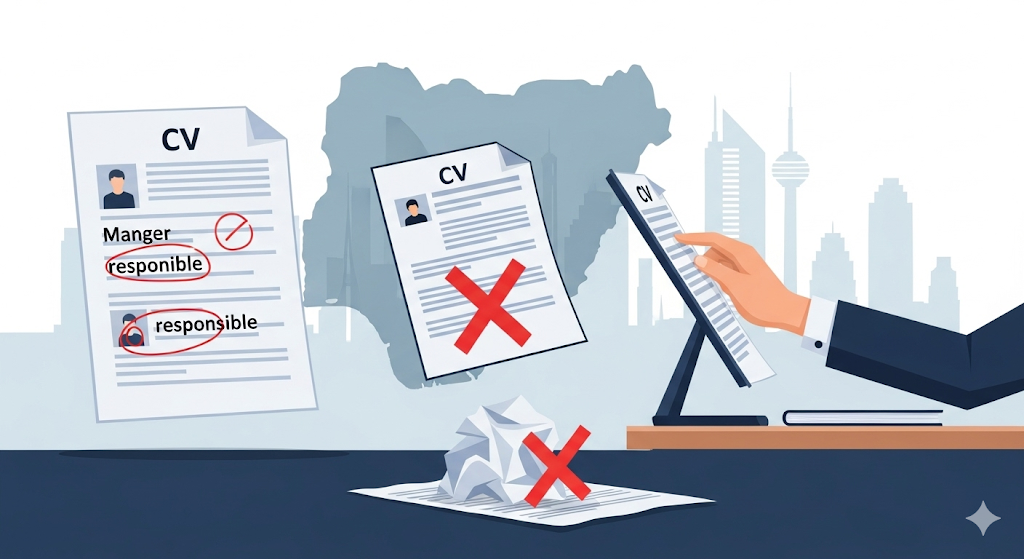
The Nigerian job market is a relentless battlefield. For every advertised vacancy, especially in major hubs like Lagos, Abuja, or Port Harcourt, hundreds, if not thousands, of hopeful candidates submit their applications. It’s a high-volume, high-stakes game where recruiters and hiring managers are overwhelmed and have very little time. They are not looking for reasons to hire you initially; they are looking for reasons to say “no” quickly to shrink the overwhelming pile of applications down to a manageable shortlist. This means that small, seemingly insignificant mistakes on your application can have fatal consequences for your candidacy.
You might be the most qualified person for the job. You could have the perfect experience, the right degree, and the ideal skills. But if your application contains one of these common red flags, there is a very high chance your CV will be discarded in less than 30 seconds, long before your qualifications are ever truly considered. These are the unforced errors, the easily avoidable slip-ups that sabotage countless talented Nigerians in their job search every single day.
Understanding these mistakes is the first step toward building a bulletproof application strategy. It’s about moving beyond just being qualified and learning how to present your qualifications professionally and strategically. In this guide, we will break down the five most common application mistakes that lead to immediate disqualification in the Nigerian context and provide clear, actionable steps to ensure you never make them again.
Mistake 1: Submitting a Generic, Untailored CV
This is, without question, the cardinal sin of job applications. You create one master CV—a “one-size-fits-all” document that lists everything you’ve ever done—and you send this exact same file for every single job opening, regardless of the industry, role, or company. This “spray and pray” method is incredibly common because it’s easy, but it is also spectacularly ineffective and signals a lack of serious interest to any discerning recruiter.
Why It’s an Instant Disqualification
Imagine a recruiter at a top Nigerian bank hiring for a “Risk Analyst.” They need someone with experience in financial modeling, regulatory compliance, and data analysis. If the first thing they see on your CV is your “Professional Summary” describing you as a “Creative Social Media Strategist,” they will not waste another second. They won’t dig through your work history to find that one internship you did at a bank three years ago. They have 200 other CVs to look at, and they will move on to the one that speaks their language immediately. A generic CV tells the recruiter you are not truly interested in their job, you are just desperate for any job. It shows a lack of effort and respect for their time.
How to Avoid It
- Dissect the Job Description: Before you apply, treat the job description like an exam question. Print it out or copy it into a document. Highlight the key skills, qualifications, and responsibilities. These are the keywords the recruiter and any Applicant Tracking System (ATS) will be looking for.
- Create a “Master CV”: Have a comprehensive document for your own records that includes every single job, project, and skill you have. This is your personal database.
- Tailor Ruthlessly for Each Application: For every single job you apply for, create a new, customized version of your CV from your master copy. Rewrite your “Professional Summary” to mirror the language of the job description. Reorder your bullet points under each job to highlight the achievements most relevant to this new role. If the job requires strong “Project Management” skills, ensure that phrase and related accomplishments are front and center.
Mistake 2: Having an Unprofessional Online Presence and Email Address
Before a recruiter even finishes reading your CV, they might do a quick search for you online. What they find can either reinforce your professional image or completely destroy it. Your digital footprint is part of your application. This includes your email address, your LinkedIn profile, and any other public social media accounts.
Why It’s an Instant Disqualification
Your application is your first professional handshake. If your email address is hotboy4lagos@yahoo.com or sweetdiva_2k5@gmail.com, you have failed the first test of professional judgment. It seems trivial, but to a recruiter, it signals a lack of seriousness and an inability to understand professional norms. Similarly, if your LinkedIn profile is incomplete, has a blurry photo of you at a party, or contradicts the information on your CV, it creates a massive red flag. They will assume you are either careless or dishonest—both are disqualifying traits.
How to Avoid It
-
- Create a Professional Email Address: This is non-negotiable and takes two minutes. The standard, safest formats are
FirstName.LastName@email.comorF.LastName@email.com. Use this email exclusively for all your professional correspondence. - Sanitize and Optimize Your LinkedIn Profile: Your LinkedIn should be a complete, professional extension of your CV. This means a clear, professional headshot (not a selfie), a headline that matches your career goals, a detailed “About” section, and experience descriptions that align with your CV.
- Create a Professional Email Address: This is non-negotiable and takes two minutes. The standard, safest formats are
–
- Audit Your Public Social Media: Recruiters do look. Go through your public-facing profiles like Twitter, Instagram, or Facebook. Remove any unprofessional photos, controversial comments, or anything that you wouldn’t want a future boss to see. Either make your accounts private or curate them to reflect a professional image.
Mistake 3: Ignoring Instructions in the Job Application
Job adverts often contain very specific instructions. “Submit your CV and Cover Letter as a single PDF document.” “Use the subject line: ‘Application for Marketing Associate – MA2025’.” “Do not call the office regarding your application.” These instructions are not suggestions; they are the first, simplest test of your ability to follow directions.
Why It’s an Instant Disqualification
When a recruiter receives 500 applications, they need simple ways to filter people out. An applicant who cannot follow basic instructions is an easy first cut. If you fail to name your file correctly, it might get lost in their system. If you send a .docx file when they asked for a PDF, it shows you didn’t read the ad carefully. If you call the office after being told not to, it shows a lack of respect for their process. To a recruiter, this carelessness suggests that you will be a difficult employee who cannot be trusted with more complex tasks. It’s a simple test of attention to detail, and a surprising number of candidates fail it.
How to Avoid It
-
- Read the Entire Job Advert Twice: Before you do anything, read the job description and application instructions from top to bottom. Then, read it again, slowly.
- Create a Checklist: For each application, quickly jot down the specific instructions. Did they ask for a cover letter? Is there a specific file format? Is there a required subject line for the email? Check off each item as you complete it.
–
- Follow Naming Conventions Precisely: If they ask you to name your file
YourName_CV_JobTitle.pdf, do exactly that. Don’t name itMy CV.pdf. This helps them stay organized and shows you are detail-oriented.
Mistake 4: Making Glaring Typos and Grammatical Errors
Your CV and cover letter are samples of your professional work product. They are a direct reflection of your diligence, your education, and your communication skills. Spelling mistakes, typos, and poor grammar are the fastest way to signal carelessness and a lack of professionalism.
Why It’s an Instant Disqualification
In a competitive market like Nigeria’s, excellence is the standard. A typo for a common word (e.g., writing “manger” instead of “manager”) is a glaring error that suggests you don’t care enough to proofread your own application. For roles that require strong written communication (which is most professional roles), such errors are fatal. The recruiter will immediately think, “If this person is this careless on an application where they are supposed to be putting their best foot forward, how careless will they be with client emails or internal reports?” It undermines your credibility instantly.
How to Avoid It
- Proofread, Then Proofread Again: Never send an application immediately after writing it. Step away for a few hours, then come back and read it with fresh eyes.
- Read It Aloud: This technique helps you catch awkward phrasing and run-on sentences that your eyes might skim over when reading silently.
- Use Technology: Use tools like Grammarly or the built-in spell checker in your word processor. These tools are not perfect, but they will catch the most obvious mistakes.
- Get a Second Pair of Eyes: This is the most effective method. Ask a friend, family member, or mentor who has strong English skills to review your documents for you. They will almost always spot something you missed.
Mistake 5: Focusing on Duties Instead of Quantifiable Achievements
Many candidates make the mistake of writing their work experience section like a job description. They list the duties they were responsible for, but they fail to show the impact they actually made. A recruiter knows what an “Accountant” does; they want to know how well you did it.
Why It’s an Instant Disqualification
A CV that lists only duties is passive and uninspiring. It doesn’t differentiate you from anyone else who has held the same title. It provides no evidence of your value or your ability to deliver results. A recruiter scanning your CV is looking for impact. When they see a CV full of achievements with numbers, percentages, and tangible outcomes, it immediately grabs their attention. An achievement-oriented CV is engaging and proves your worth, while a duty-oriented CV is boring and easily forgettable.
How to Avoid It
- Think in Terms of STAR: For each role, think about your accomplishments using the STAR method (Situation, Task, Action, Result). What was the problem? What were you supposed to do? What specific action did you take? What was the positive, measurable result?
- Quantify Everything: Numbers are the most powerful tool on your CV. Go through each bullet point and ask yourself: Can I add a number here? How much money did I save? By what percentage did I increase sales? How many people did I train? How much time did I save the company?
- Use Strong Action Verbs: Start every bullet point with a powerful action verb. Instead of “Responsible for managing social media,” write “Increased social media engagement by 300% by developing and executing a new content strategy.”
Example:
Before (Duty-focused): “Managed the company’s inventory.”
After (Achievement-focused): “Implemented a new inventory management system that reduced stock discrepancies by 95% and saved the company an estimated ₦3 million annually in lost product.”
Conclusion: Control the Controllables
The Nigerian job search can often feel like a lottery, but it doesn’t have to be. While you can’t control the number of other applicants or the biases of a recruiter, you have absolute control over the quality of your application. The five mistakes outlined above are not about a lack of qualifications; they are about a lack of care, strategy, and professionalism. By consciously avoiding these pitfalls, you lift your application out of the rejection pile and into the hands of the decision-makers. Take your time, be meticulous, and present the best possible version of yourself on paper. In this competitive market, that is how you earn the right to be noticed.