A Step-by-Step Guide to Getting a Job in the Nigerian Banking Sector
For decades, a career in the Nigerian banking sector has been a hallmark of success and stability. The towering, glass-clad headquarters of banks like Zenith, GTB, and Access Bank are more than just office buildings; they are symbols of ambition and professional achievement that dominate the skylines of Lagos, Abuja, and other major cities. A job in a bank is often seen as a golden ticket—a pathway to a secure, well-compensated, and respectable career with a clear trajectory for growth.
However, this prestige also makes the banking sector one of the most competitive industries for job seekers in Nigeria. Every year, thousands of bright, ambitious graduates and young professionals apply for a limited number of coveted positions, particularly in the highly sought-after graduate trainee programs. The recruitment process is notoriously rigorous, multi-staged, and can often feel like a black box, leaving many qualified candidates feeling frustrated and confused.
The good news is that the process is not random. Banks are looking for a specific set of qualifications, skills, and personality traits, and with the right preparation and strategy, you can significantly increase your chances of success. This comprehensive, step-by-step guide will demystify the entire process, providing you with a clear roadmap to navigate the challenges and land a fulfilling job in the Nigerian banking industry in 2025.
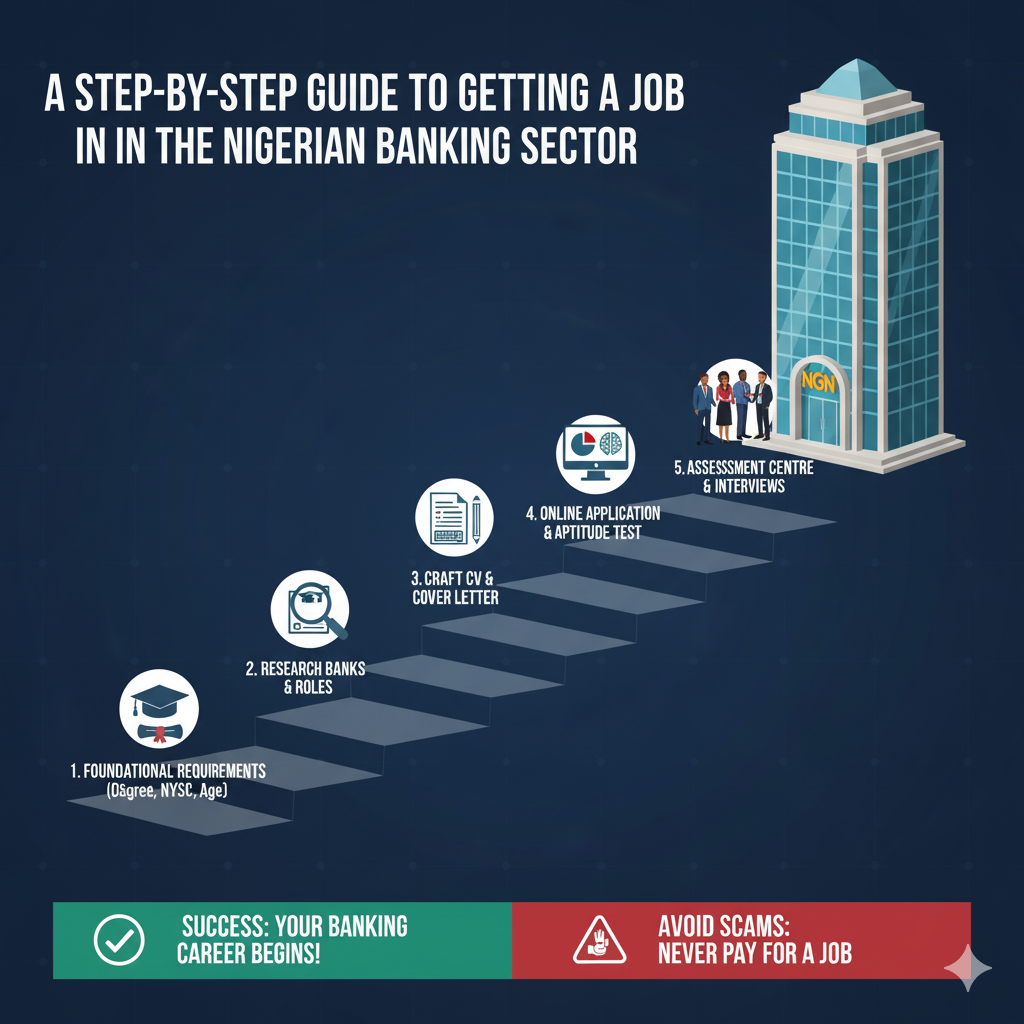
Step 1: Getting the Foundational Requirements Right
Before you even think about tailoring your CV or preparing for an interview, you must ensure you meet the non-negotiable baseline requirements. Nigerian banks, especially the top-tier commercial ones, are very strict with their initial screening criteria.
Educational Qualifications
Your university degree is the first hurdle. While the absolute minimum is typically a Second-Class Honours, Lower Division (2:2), the reality of the competition means that candidates with a Second-Class Honours, Upper Division (2:1) or a First Class degree have a significant advantage. It is not impossible to get in with a 2:2, but you will need to compensate with exceptional performance in other areas, such as professional certifications or relevant experience.
A common misconception is that you must have studied a finance-related course. While degrees in Economics, Accounting, Business Administration, or Banking and Finance are highly relevant, banks are massive organizations with diverse needs. They actively recruit from all disciplines, including STEM (for roles in tech and data analysis), Law (for legal and compliance departments), and even the Arts and Humanities (for communications and customer relations roles). What matters most is demonstrating strong analytical and numerical skills, regardless of your field of study.
Mandatory Certifications
For graduates who studied in Nigeria, the National Youth Service Corps (NYSC) discharge or exemption certificate is a mandatory requirement. There is no way around this for graduate-level entry. Ensure you have your certificate ready before you begin your applications.
The Unspoken Age Limit
This is a critical point that is often not explicitly stated in job adverts but is a firm rule in practice. Most graduate trainee programs in Nigerian banks have an age limit, typically 26 or 27 years old at the time of application. It’s a way for them to filter the vast number of applicants and invest in talent they can mold over a long career. If you are above this age, you might need to target more experienced hire roles rather than entry-level graduate programs.
Step 2: Understanding the Banks and the Roles Available
Not all banks are the same, and a “banking job” is not a monolith. Strategic job seekers take the time to understand the landscape and identify where they would be the best fit.
Types of Banks, Types of Careers
The Nigerian banking sector includes Commercial Banks (the largest employers), Merchant Banks (focused on corporate clients), Microfinance Banks (serving small businesses and individuals), and Development Banks (like the Bank of Industry). The culture, pace, and type of work can vary significantly. A role in a fast-paced, tech-driven commercial bank in Lagos will be very different from a position in a development bank in Abuja.
Career Paths Beyond the Teller
The most visible bank employee is the teller, but this is just one of many career paths. To truly stand out, you need to show an understanding of the different functions within a bank. Common entry points include:
- Retail and Commercial Banking: This is the customer-facing side, including roles in customer service, relationship management for individuals and SMEs, and wealth management.
- Corporate and Investment Banking: This division serves large corporations and governments, dealing with complex financing, loans, and investment strategies. It is highly analytical and competitive.
- Bank Operations: This is the “engine room” of the bank. Roles include transaction processing, IT support, clearing, and ensuring the smooth day-to-day running of the bank’s systems.
- Digital Banking and Fintech: This is the fastest-growing area. Banks are heavily investing in their digital products, creating roles for product managers, UI/UX designers, data analysts, and digital marketers.
- Control Functions: These roles ensure the bank operates safely and legally. They include Risk Management, Internal Audit, and Compliance. These are ideal for detail-oriented and analytical individuals.
Research a few banks you admire. Read their latest annual reports, follow their executives on LinkedIn, and understand their strategic focus. This knowledge will be invaluable in your application and interviews.
Step 3: Crafting a CV and Cover Letter That Stand Out
Your CV is your marketing document. With recruiters spending only a few seconds on each one, it needs to make an immediate impact.
The Banking CV
Keep it clean, professional, and concise—ideally one page for an entry-level candidate. Use a simple, readable font and avoid flashy graphics or photos. Focus on quantifying your achievements. Instead of saying you were “Class representative,” say you “Represented a class of 150 students, acting as a liaison with faculty and organizing three academic seminars.” During your NYSC, instead of “Performed administrative duties,” try “Improved office filing system, reducing document retrieval time by 20%.” Highlight skills that are crucial in banking: numeracy, analytical ability, communication, attention to detail, teamwork, and proficiency in Microsoft Excel.
The Tailored Cover Letter
A generic cover letter is a wasted opportunity. Your cover letter should be a bridge between your CV and the specific bank you are applying to. In the first paragraph, state the role you are applying for. In the body, highlight 2-3 of your key skills or experiences and explicitly link them to the requirements of a banking career. In the final paragraph, show your genuine interest by mentioning something specific about the bank—perhaps their recent digital banking innovation or their commitment to SME financing. This shows you’ve done your homework.
Step 4: The Application and Aptitude Test Stage
This is where the volume game begins, and the first major filter is applied.
Where and How to Apply
The most common channel for graduate recruitment is the banks’ official career portals. Set up profiles on the websites of your target banks and create alerts. Also, keep a close eye on LinkedIn and major Nigerian job boards like Jobberman and MyJobMag. Follow the application instructions to the letter.
Preparing for the Aptitude Test
The computer-based aptitude test is designed to eliminate a large percentage of applicants. Passing it is non-negotiable. These tests are typically administered by assessment companies like SHL, GMAT, or Dragnet and usually cover:
- Numerical Reasoning: Interpreting data from graphs and tables to perform calculations.
- Verbal Reasoning: Reading passages and answering questions to test comprehension and logic.
- Abstract/Logical Reasoning: Identifying patterns in shapes and sequences.
The key to success is practice. There are numerous online resources and forums (like Nairaland) that have past questions from Nigerian bank tests. Practice under timed conditions to simulate the real exam environment. This is a stage where preparation directly translates to success.
Step 5: Acing the Assessment Centre and Interviews
If you pass the test, you will likely be invited to an assessment centre or a series of interviews. This is where your soft skills are evaluated.
The Assessment Centre
This is typically a half-day or full-day event where you will participate in various exercises, including:
- Group Exercises: You will be put in a group to solve a problem or a case study. Recruiters are watching for teamwork, leadership potential, and communication skills. The goal is to contribute constructively, listen to others, and help the team reach a consensus. Don’t dominate the conversation, but don’t be silent either.
- Presentations: You may be asked to prepare and deliver a short presentation on a given topic. This tests your analytical skills and your ability to communicate clearly and confidently.
The Interviews
You may face one or multiple rounds of interviews. The first is often with HR and focuses on behavioral questions to assess your personality and cultural fit. Be prepared to answer questions like, “Tell me about a time you worked in a team,” or “Describe a situation where you had to solve a difficult problem.” Use the STAR method (Situation, Task, Action, Result) to structure your answers with concrete examples.
The final interview is often with senior management and will be more technical. They might ask about your knowledge of the Nigerian economy, recent financial regulations, or their bank’s position in the market. Your research from Step 2 will be crucial here. Always dress in formal business attire, maintain eye contact, and have a few intelligent questions ready to ask them. This shows your engagement and interest.
Conclusion: Your Banking Career Awaits
Getting a job in the Nigerian banking sector is a marathon, not a sprint. It is a rigorous, multi-layered process designed to select the very best from a vast pool of talent. However, it is a transparent and merit-based path for those who are willing to put in the work. By ensuring you meet the foundational requirements, understanding the industry, crafting a compelling application, diligently preparing for the aptitude tests, and confidently showcasing your skills in interviews, you can turn a daunting challenge into a successful career move.
The journey requires patience, resilience, and a strategic approach. Each step builds upon the last, moving you closer to your goal. With thorough preparation and a clear understanding of what banks are looking for, you can successfully navigate the process and launch a rewarding career in one of Nigeria’s most vital industries.