Is It Who You Know? Tackling Nepotism in Your Nigerian Job Search
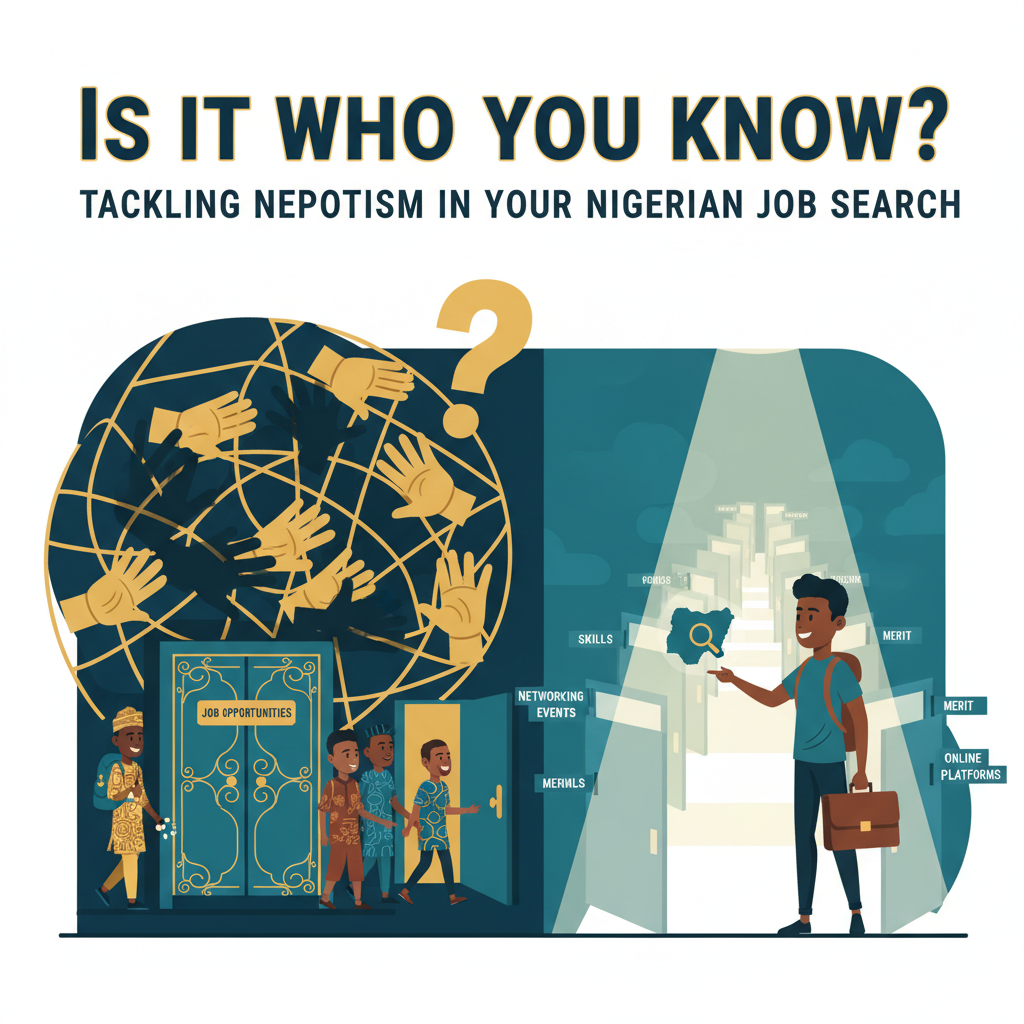
You’ve seen the job advert. It feels like it was written for you. The required skills match your qualifications perfectly, the company’s mission resonates with you, and the location is ideal. You spend the next three hours meticulously tailoring your CV, crafting a compelling cover letter that highlights your achievements, and submitting your application with a surge of optimism. Days turn into weeks. Silence. Then, through a friend of a friend, you hear the news: the position was filled by the Managing Director’s nephew who just finished his NYSC.
For millions of talented and qualified Nigerians, this scenario is not a pessimistic fiction; it is a frustrating and demoralizing reality. The phrase “it’s not what you know, but who you know” feels less like a cynical proverb and more like the unwritten rule of the Nigerian job market. The concepts of “man-know-man,” “long leg,” and “connectocracy” are so deeply embedded in our society that it can often feel like your qualifications and hard work are secondary to your surname or your father’s contact list.
This reality can lead to despair, causing many to question the point of striving for excellence. But what if we could reframe the problem? What if, instead of being defeated by the system, we learned how to strategically navigate it? This guide is not a complaint about the unfairness of nepotism—we already know it exists. This is a strategic playbook for the ambitious Nigerian job seeker. It’s about acknowledging the elephant in the room and then learning how to tame it. We will explore how to tackle this challenge by shifting your mindset, building genuine value, and redefining what “who you know” truly means.
The Elephant in the Room: Acknowledging Nigerian Nepotism
Before we can build a strategy, we must first honestly define the problem. Nepotism is the practice of favouring relatives or friends, especially by giving them jobs. In Nigeria, this often extends to cronyism (favouring associates, regardless of relation) and is influenced by ethnic and religious ties. It’s a systemic issue with deep roots, and understanding why it thrives can help us better navigate it.
Several factors contribute to its prevalence. Firstly, the staggering rate of unemployment creates a hyper-competitive environment. With hundreds or even thousands of applicants for a single position, employers look for shortcuts to filter candidates. A recommendation from a trusted source, however biased, becomes an easy filter. Secondly, we operate in a relatively low-trust society. The fear of hiring a dishonest or incompetent stranger can lead managers to default to a “known devil,” even if that devil is less qualified. Finally, our strong cultural emphasis on family and community obligations means that helping a relative secure a job is often seen not as a corrupt act, but as a duty.
Acknowledging these factors is not about excusing the practice. Nepotism stifles meritocracy, breeds resentment, and can lead to organisational incompetence. However, understanding this landscape is the first step in moving from a position of frustration to one of strategic action. The system may be flawed, but your career trajectory is not entirely at its mercy.
Your First Move: A Critical Mindset Shift
The most corrosive effect of facing constant nepotism is the development of a victim mentality. When you believe that the game is rigged and there’s nothing you can do, you stop trying. You put less effort into your applications, you stop learning new skills, and you begin to project an aura of defeat. This mindset is the real enemy. Your first and most important strategy is to consciously shift from feeling like a victim to thinking like a strategist.
The strategist acknowledges the unfair terrain but focuses intensely on the variables they can control. The strategist understands that while they can’t change who the MD’s cousin is, they *can* change their own value proposition, their network, and their approach. The goal is no longer to lament the existence of “long leg,” but to build a professional reputation so strong that you become the person a trusted contact is proud to recommend based on merit. You will focus on being so good that it becomes a risk *not* to hire you.
Strategy 1: Redefine Connection – Build Social Capital Not Long Leg
The phrase “who you know” doesn’t have to be a dirty one. There is a world of difference between nepotism and networking. Nepotism is getting an opportunity you don’t deserve. Networking is getting an opportunity to *prove* you deserve it. Your goal is to build genuine “social capital”—a network of professional relationships built on mutual respect and value.
Leverage LinkedIn Like a Pro
LinkedIn is the most powerful networking tool at your disposal, yet many Nigerians use it as a passive CV archive. It’s time to go on the offensive.
- Optimize Your Profile: Your LinkedIn profile should be a compelling sales pitch, not a boring list of duties. Use a professional headshot, write a headline that clearly states your value (e.g., “Data Analyst passionate about helping businesses make smarter decisions”), and use the “About” section to tell your career story.
- Connect with Intent: Don’t just send random connection requests. Target recruiters, HR managers, and professionals working in the companies you admire. When you send a request, always add a personalized note. Instead of “Please give me a job,” try: “Dear [Name], I’m a recent graduate from UNILAG specializing in digital marketing. I’ve been following [Company Name]’s recent campaigns and I’m very impressed. I’d love to connect and learn more about the industry.”
- Engage and Add Value: Don’t be a silent connector. Share insightful articles about your field. Comment thoughtfully on posts by others in your network. Showcase your expertise. You want to be known for *what you know* long before you ever ask for a job.
Attend Industry Events (Virtual and Physical)
Immerse yourself in your chosen field. In a city like Lagos, there are countless industry events, seminars, and webinars happening every month. Attend events relevant to your career, whether it’s a tech meetup in Yaba or a marketing conference on Victoria Island. The goal is not to hand out your CV to everyone you see, but to learn, ask intelligent questions, and build genuine connections with peers and industry leaders.
Strategy 2: Build Undeniable Value – Become the Best Candidate
This is your ultimate weapon against nepotism. You must build a portfolio of skills, experiences, and results that make you an undeniably strong candidate. When you are exceptional, you create a dilemma for the hiring manager. They might have pressure to hire a relative, but passing up on a truly top-tier candidate who can solve their problems is a business risk.
Go Beyond Your Degree with In-Demand Skills
In the 2025 job market, your university degree is just the entry ticket. You need to supplement it with practical, in-demand skills. Identify the key skills in your industry by studying job descriptions on platforms like Jobberman and LinkedIn. Are companies asking for proficiency in data analysis with Python, experience with SEO/SEM tools, or certifications in project management? Invest in yourself through online courses on Coursera, Udemy, or local Nigerian training institutes. A certification in a high-demand skill can often be more valuable than your university grade.
Show, Do not Just Tell: Create a Portfolio
A CV lists what you claim you can do. A portfolio proves it. This is non-negotiable in today’s market.
- For a writer or content creator: Start a blog on Medium or have a professional social media page where you share your work.
- For a software developer: Your GitHub profile is your portfolio. Contribute to open-source projects or build your own small applications.
- For a graphic designer: A polished Behance or Dribbble profile is essential.
- For a digital marketer: Offer to manage the social media for a small local business for free or a small fee. Then, create a simple case study with analytics showing the growth you achieved.
A portfolio of tangible work is irrefutable proof of your competence and passion.
Strategy 3: Navigate the Process with Intelligence
With a strong network and a valuable skill set, you now need to apply your assets strategically during the job search process.
Target Companies with a Merit-Based Culture
Do your research. Not all organisations operate on a “man-know-man” basis. Generally, multinational corporations, competitive tech startups, and companies with a strong international presence tend to have more structured, merit-based hiring processes. Use platforms like Glassdoor to read reviews about a company’s culture and interview process. While no company is immune, targeting those that value merit increases your chances significantly.
Activate Your Network for Referrals (The Right Way)
Once you’ve built a genuine connection with someone in a company (from Strategy 1), you can leverage that relationship for a referral. A professional referral is not nepotism. It is someone vouching for your skills and character. When a role opens up, approach your contact professionally: “Hi [Name], I hope you’re well. I saw that [Company Name] is hiring for a [Job Title]. Based on my experience in [Skill 1] and [Project 2], I believe I’m a very strong fit. Would you be comfortable referring me or sharing my CV with the hiring team?” This approach respects their position and is based on the value you have already demonstrated.
Ace the Interview
When you do get your foot in the door, whether through a referral or a direct application, your performance is all that matters. This is where your undeniable value (Strategy 2) comes into play. Be prepared, be professional, and be ready to prove your worth. If you got the interview through a contact, your goal is to make that person look brilliant for recommending you. Your competence is the final and most important piece of the puzzle.
Conclusion: Playing the Hand You are Dealt and Winning
Let’s be honest: nepotism in the Nigerian job market isn’t going away overnight. To deny its existence is naive, but to be defeated by it is a choice. The ultimate strategy is to play the hand you are dealt with intelligence, resilience, and an unwavering focus on what you can control.
Shift your mindset from victim to strategist. Redefine “who you know” by building a powerful network of professional allies who respect your skills, not your surname. Build a portfolio of value that is so compelling that you become the candidate they can’t ignore. By combining the power of a strong network with the proof of exceptional competence, you create a career momentum that can break through barriers. It’s about turning the frustrating question of “Is it who you know?” into a powerful statement: “They will want to know you because of what you can do.”